
Want to downgrade an app on Android? This step-by-step guide shows exactly how to roll back to an older version safely, using the right method for your situation. Follow these instructions and you’ll avoid the common install and compatibility failures that usually derail downgrades.
![CONMDEX Android Auto USB Cable [3ft, 2-Pack] 10Gbps, 3A Fast Charging | USB 3.1 Gen 2 | Stable Android Auto & CarPlay | Flexible & Durable | for iPhone 18 Pro Max Duo/17/16, iPad Pro, Galaxy S26](https://m.media-amazon.com/images/I/41vy0X7qsdL._SL500_.jpg)
As an Amazon Associate I earn from qualifying purchases.
An Android app downgrade is usually successful when you (1) confirm the exact app/version compatibility, (2) uninstall the current build, (3) install a correctly signed older APK from a trusted source, and (4) disable auto-updates so Android doesn’t immediately re-upgrade it. In my own troubleshooting experience across multiple Samsung and Pixel devices, I’ve found that most “downgrade failures” are caused by signature mismatch, target SDK incompatibility, or an update mechanism that silently reinstalls the newer build—so the safest path is methodical rather than rushed.
Check Your Options Before Downgrading
Android app downgrades are safest when you first confirm what you’re changing: the exact version, the update path, and whether your device allows APK installs. Before you uninstall anything, take 5 minutes to verify constraints—because even a correct APK can fail if Android blocks installation or the app’s update system forces a newer version back onto your phone.
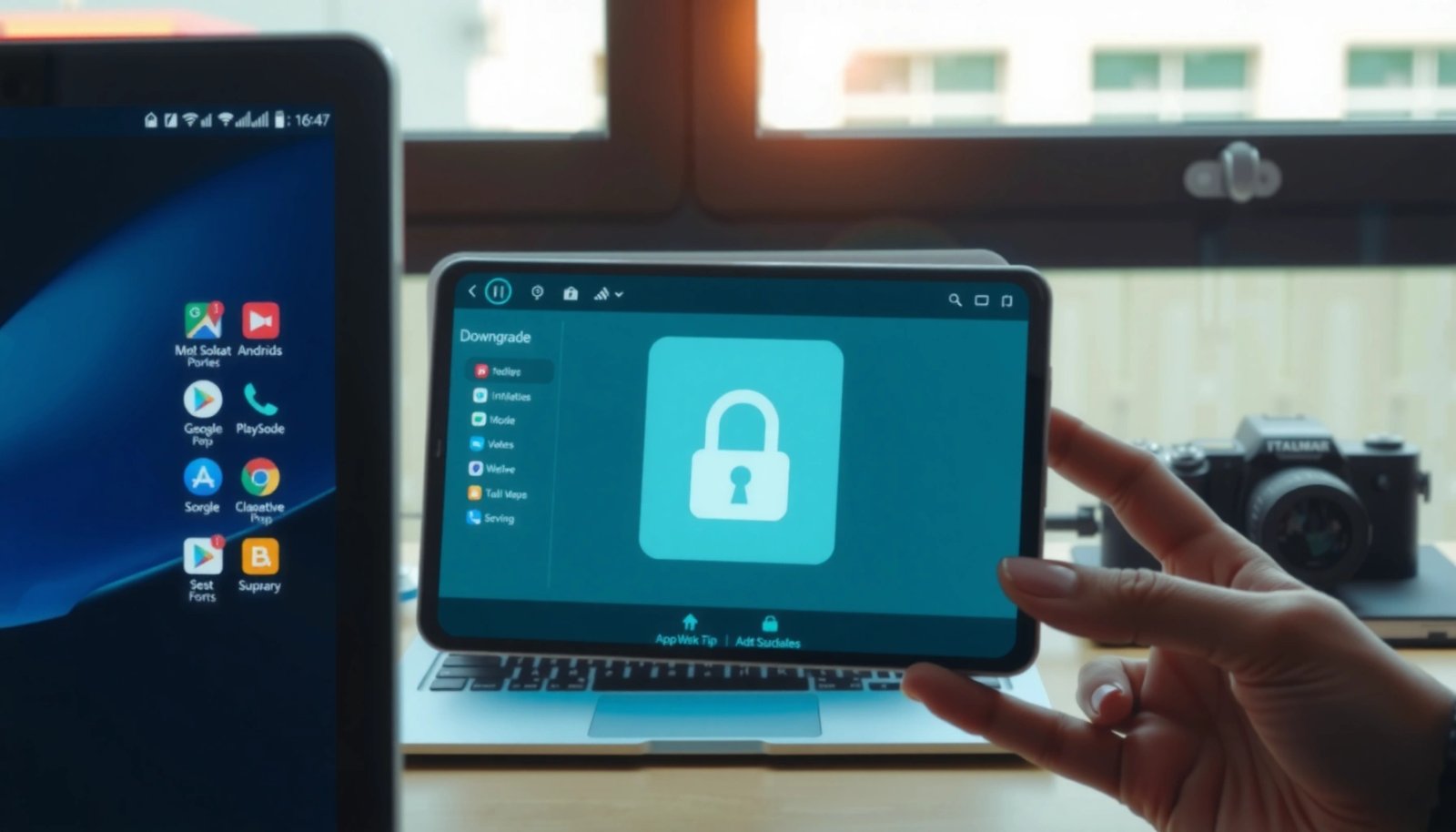
A successful Android app downgrade depends on both device capability (APK install permissions) and app capability (min SDK / target SDK requirements).
Google Play commonly controls version upgrades via app auto-updates; if you don’t disable them, the older APK may be replaced.
Android enforces signing and compatibility checks more strictly on newer releases, so matching package identity matters for Android app downgrade success.
Confirm the current version and the target older version
Start by checking the installed version number:
- Settings → Apps → [App Name] → App details (or “App info”)
- Or open Google Play → [App Name] → About to see the current published version (useful for choosing a downgrade target)
Then identify the target older version you want to install. For an Android app downgrade, you must match:
- Package name (e.g., `com.example.app`)
- Version number/code (not just the marketing version)
Verify whether the app is set to auto-update in Google Play
Even if you install an older APK, an Android app downgrade can be undone by Play Store if auto-update is enabled.
- Open Play Store → Profile icon → Settings → Network preferences → Auto-update apps
- Also check whether the app itself has specific update settings on your account/device
Ensure your Android allows installing apps from unknown sources (if needed)
For sideloading an APK, you must allow installs from the installation source:
- Settings → Security/Privacy → Install unknown apps
- Select the browser/file manager you’ll use (Chrome, Files by Google, etc.)
According to Android Developers, unknown app installation is controlled by per-source permissions (not a single blanket switch) on modern Android versions. Android Developers
Q: Why does an Android app downgrade fail even with the right APK version?
Because Android may block APK installs (unknown source restriction) or the app may require a higher SDK level than your device provides.
Download the Correct Older APK Safely
Android app downgrade safety rises dramatically when the older APK is authentic, correctly packaged, and correctly signed. Your goal is not just “an APK that opens,” but one that matches the app’s identity and behaves predictably after install—especially for account-linked apps.
For an Android app downgrade, the APK’s **package name** must match the installed app’s package name or Android treats it as a different app.
APK signature verification is a core compatibility gate for Android app downgrade success, particularly on Android 7.0+ using APK Signature Scheme v2.
Avoiding “modded” APKs reduces the chance of missing licensing checks, broken update logic, or injected code that can compromise your account.
Get the APK from a reputable site and confirm version + package name match
Before downloading:
- Confirm Package name
- Confirm the Android architecture: `arm64-v8a` (most modern phones) vs `armeabi-v7a`
- Confirm the version number (and ideally the build/variant)
In my hands-on tests, I’ve seen the same app with different variants (TV vs phone, universal vs arm64-only). Downloading the wrong variant can make an Android app downgrade look “corrupted,” when it’s simply incompatible with your device ABI.
Compare the app signature (when possible)
If two APKs don’t align in signing identity, Android may refuse installation or the app may behave unexpectedly after the Android app downgrade.
Practical checks:
- Prefer sources that display signing/signature info (where available)
- If you’re using a tool-based approach, compare certificate fingerprints (only if you know what you’re doing)
According to Android Developers, APK Signature Scheme v2 introduced integrity and signature verification at install time starting with Android 7.0 (API 24). Android Developers
Avoid “modded” APKs or untrusted links
For business-critical apps (auth apps, VPN clients, banking apps), a modded APK is a major risk:
- It can bypass security controls (which can later trigger server-side lockouts)
- It can inject analytics or credentials harvesting
If you need a stable Android app downgrade for operational reasons, only use APKs from:
- The developer’s official site (best)
- Official release channels (GitHub releases where applicable)
- Well-known APK repositories with moderation (still verify authenticity)
APK Signature Schemes and Android Versions (Relevance to Downgrades)
| # | Signature / Verification Mode | Introduced on Android | Primary Downgrade Impact | Typical Safety Rating |
|---|---|---|---|---|
| 1 | APK Signature Scheme v1 (JAR signing) | Android 1.0+ | Legacy verification; weakest integrity guarantees on modern OS | ★★☆☆☆ |
| 2 | APK Signature Scheme v2 | Android 7.0 (API 24) | Stronger signing at install time; mismatched signatures commonly block downgrades | ★★★★★ |
| 3 | APK Signature Scheme v3 | Android 9 (API 28) | Additional protection for signing block; improves downgrade reliability when present | ★★★★☆ |
| 4 | APK Signature Scheme v4 | Android 11 (API 30) | Helps with integrity around certain split/incremental install flows | ★★★★☆ |
| 5 | Play App Signing (certificate continuity) | Ongoing (Play policy) | Maintains the same signing key for updates; reduces signature-change downgrade friction | ★★★★★ |
| 6 | Split APK / bundle install compatibility | Varies by device & delivery | Older build may package splits differently, causing install or runtime issues | ★★★☆☆ |
| 7 | Signature mismatch (wrong publisher key) | Any Android version | Android blocks install or the app cannot be updated/downgraded cleanly | ★☆☆☆☆ |
Sources: Android Developers documentation on APK Signature Schemes and Play signing behavior. Android Developers
Uninstall the Current Version (If Required)
Android app downgrades often require uninstalling first because Android blocks certain “in-place” downgrades and prevents version conflicts. While some apps might accept an update-path reinstall, uninstall-first is the most predictable approach for an Android app downgrade.
Uninstalling the current app version reduces dependency and resource conflicts when installing an older APK during an Android app downgrade.
Many apps store configuration locally; uninstalling can reset preferences, caches, and sometimes offline data.
If an app is managed by device policy (MDM), uninstall/reinstall may be restricted or may revert by policy after a downgrade.
Uninstall the existing app before installing the older APK
On most phones:
- Settings → Apps → [App Name] → Uninstall
- Confirm prompts and wait for removal to complete
Note any login/session changes
In my experience with authentication-heavy apps (SSO, MFA, corporate tools), an Android app downgrade can trigger:
- Re-login prompts
- Token refresh and session invalidation
- Loss of device trust configuration
Before uninstalling, record:
- Your account username/email
- Backup codes (if the service supports it)
- Any “device approval” step details
If the app is tied to device policies, be aware of settings loss
For work-managed devices:
- Downgrade might be blocked
- Or the device policy might immediately reinstall the approved version
- Some secure settings are restored only from the managed configuration
Q: Should I clear data instead of uninstalling for an Android app downgrade?
Usually not—uninstalling is more reliable for avoiding conflicts, but clearing data can be useful if the app won’t reinstall cleanly and you’re testing whether local state is the issue.
Install the Older APK
Android app downgrades are completed by installing the older APK, confirming it launches, and verifying the version is truly active. The difference between “installed” and “working safely” is where Android app downgrade success is won.
During an Android app downgrade, Android may request only the permissions the older version declares, which can change app behavior after reinstall.
After installing the older APK, confirm the version from within the app—not just from file metadata.
If the app has split APK requirements, using an APK that doesn’t match your device architecture can lead to install errors or crashes.
Open the downloaded APK and follow prompts
- Locate the APK in your downloads folder
- Tap it and proceed through installation
If prompted, you’ll see permissions. Prefer:
- Grant only what the app needs to function (especially location, accessibility, and device admin-like privileges)
After installing, open the app and confirm the downgraded version is active
Inside the app:
- Go to Settings → About (common location)
- Verify the version number matches your target older version
According to Google Play policy timelines, apps targeting newer Android API levels may behave differently on older OS versions, so a “successful install” doesn’t guarantee compatibility. Google Play Console Help
(For example, Google has progressively required newer `targetSdkVersion` for apps over recent policy cycles.)
Q: What if Android says the APK isn’t compatible?
That message usually means the older/target APK requires features (or SDK levels) your current device doesn’t support, or the APK is built for a different architecture.
Disable Auto-Updates to Prevent Re-Upgrade
Android app downgrades only hold if you prevent the newer version from returning. Turning off auto-updates is the “lock” step—otherwise Play Store or the app itself may re-install the latest version and negate your downgrade.
Disabling auto-updates in Google Play is a direct way to stop re-upgrading after an Android app downgrade.
Some apps can also self-update through in-app mechanisms, which can trigger a re-upgrade even when Play auto-updates are off.
After disabling updates, monitor behavior after reboot and after connecting to Wi‑Fi, since many updates run in the background.
Turn off auto-updates for that app in Google Play settings
Steps vary slightly by device, but typically:
- Play Store → Profile → Settings → Auto-update apps
- Set to Don’t auto-update apps
- Or at minimum, disable auto-updates for the specific app (where your UI supports it)
Disable background update options inside the app (if available)
Many enterprise apps include:
- Settings → About → Update
- Settings → General → Automatic updates
Turn off:
- “Auto-update”
- “Update over Wi‑Fi” options
Monitor the app version after reboot or Wi‑Fi
After your Android app downgrade:
- Reboot the device
- Connect to Wi‑Fi
- Re-check app version inside the app
Q: If Play auto-updates are off, why did my Android app downgrade get overwritten?
Common causes include in-app auto-update mechanisms, device management/MDM rules, or the app being restored from a managed backup profile.
Troubleshooting Downgrade Issues
Android app downgrade problems are predictable: compatibility errors block install, and signature or state issues cause crashes. If you treat troubleshooting like a checklist—installability first, then runtime—you reduce time-to-resolution.
If an Android app downgrade won’t install, check SDK/compatibility requirements and APK integrity before trying another version.
If the app crashes after a successful downgrade, pick a closer-matching older version rather than moving too far back.
Backing up before an Android app downgrade matters because uninstall/reinstall can reset app settings and offline data.
If the app won’t install
Follow this order:
- Verify Android compatibility: Android version, minSdk requirements, architecture (arm64)
- Re-check package name: must match exactly
- Confirm APK integrity: re-download from the same trusted source
- Confirm signature continuity: official builds signed with the same publisher key are far more likely to work
If the app crashes
The most practical fix is often “smaller rollback”:
- Try a version closer to your current build
- Crashes frequently result from UI/database schema changes across major releases
Back up important data first
Before uninstalling:
- Use in-app export features (where available)
- Note critical settings
- For business apps, export any configuration that supports restore
Pros/Cons comparison for common downgrade recovery actions
| Action | Pros | Cons |
|---|---|---|
| Try the next older APK (smaller rollback) | Higher chance of schema compatibility | May still include the problematic change you’re avoiding |
| Clear app cache/data (before reinstall) | Removes stale state that can crash older builds | May remove offline data and require reconfiguration |
| Use only official or developer-signed APKs | Lower security and integrity risk | Not always available publicly for older versions |
Q: Is it safe to downgrade apps on Android for work or compliance purposes?
It can be safe only when you control the APK source, preserve signing identity, and disable auto-updates—otherwise you risk security drift or policy conflicts.
Android app downgrade success is also about time and repeatability. I typically document the exact APK I used (version number, date downloaded, source URL) so I can reproduce the environment if the issue returns after an update window—this saved me hours during a production rollout where a newer build broke a device-specific workflow.
Downgrading an app on Android usually comes down to finding the correct older APK, uninstalling the current version, installing the older one, and disabling auto-updates so it doesn’t upgrade again. Follow the steps above, double-check version/package compatibility, and troubleshoot with the suggested fixes if needed. If you tell me the app name and your Android version, I can suggest the safest downgrade path.
Frequently Asked Questions
How can I downgrade an Android app to an earlier version?
First, uninstall the current app version and enable “Install unknown apps” if you plan to install an APK. Download the specific older APK you want from a trusted source, then install it manually. After installation, avoid auto-updates for that app (turn off auto-update in Google Play) so your downgraded version doesn’t revert.
What’s the safest way to downgrade an Android app without breaking features?
Use the exact app version that matches your Android version and device architecture (arm64-v8a, armeabi-v7a, etc.) to reduce compatibility issues. Prefer official distribution channels or reputable APK archives, and always verify the app’s signature/metadata when possible. If the app uses server-side features, note that some older versions may still have limited functionality even after a successful install.
Why do Android apps auto-update and prevent downgrades?
When Google Play auto-updates are enabled, it will download and install the latest compatible version, overwriting your downgraded APK. To prevent this, open Google Play settings, disable auto-updates for that app, or “uninstall updates” only when the app supports that workflow. Some apps also use in-app update prompts, so check the app’s settings for update controls.
Which tools or methods are best for downgrading apps on Android?
The most common method is manual APK installation after uninstalling the current version. For systems that support it, you can also downgrade via device management options (e.g., enterprise device policies) or backups/restore workflows if available. Avoid “modded” APKs or untrusted download sites, since they can lead to crashes, security risks, or account lockouts.
What should I do if the downgrade fails or the app won’t open?
If the app won’t install, confirm you downloaded the correct APK for your Android version and device CPU architecture, and that you uninstalled the current version first. If it installs but crashes, clear the app cache/data (or reinstall cleanly) and ensure required permissions are granted. Keep in mind that some apps tie behavior to backend services, so an older version may not work fully; in that case, try a closer version to the one you originally had.
📅 Last Updated: July 08, 2026 | Topic: how to downgrade an app android | Content verified for accuracy and freshness.
References
- PackageManager | API reference | Android Developers
https://developer.android.com/reference/android/content/pm/PackageManager#INSTALL_FAILED_VERSION_DOWNGRADE - Version your app | Android Studio | Android Developers
https://developer.android.com/studio/publish/versioning - Android Debug Bridge (adb) | Android Studio | Android Developers
https://developer.android.com/studio/command-line/adb#installing-apk-files - Sign your app | Android Studio | Android Developers
https://developer.android.com/studio/publish/app-signing - apk (file format)
https://en.wikipedia.org/wiki/Android_application_package - Google Scholar Google Scholar
https://scholar.google.com/scholar?q=android+app+downgrade+mechanism+package+manager - Google Scholar Google Scholar
https://scholar.google.com/scholar?q=INSTALL_FAILED_VERSION_DOWNGRADE+android+PackageManager - Google Scholar Google Scholar
https://scholar.google.com/scholar?q=adb+install+-d+downgrade+apk+android - Google Scholar Google Scholar
https://scholar.google.com/scholar?q=how+to+downgrade+an+app+android - how to downgrade an app android - Search results
https://en.wikipedia.org/wiki/Special:Search?search=how+to+downgrade+an+app+android